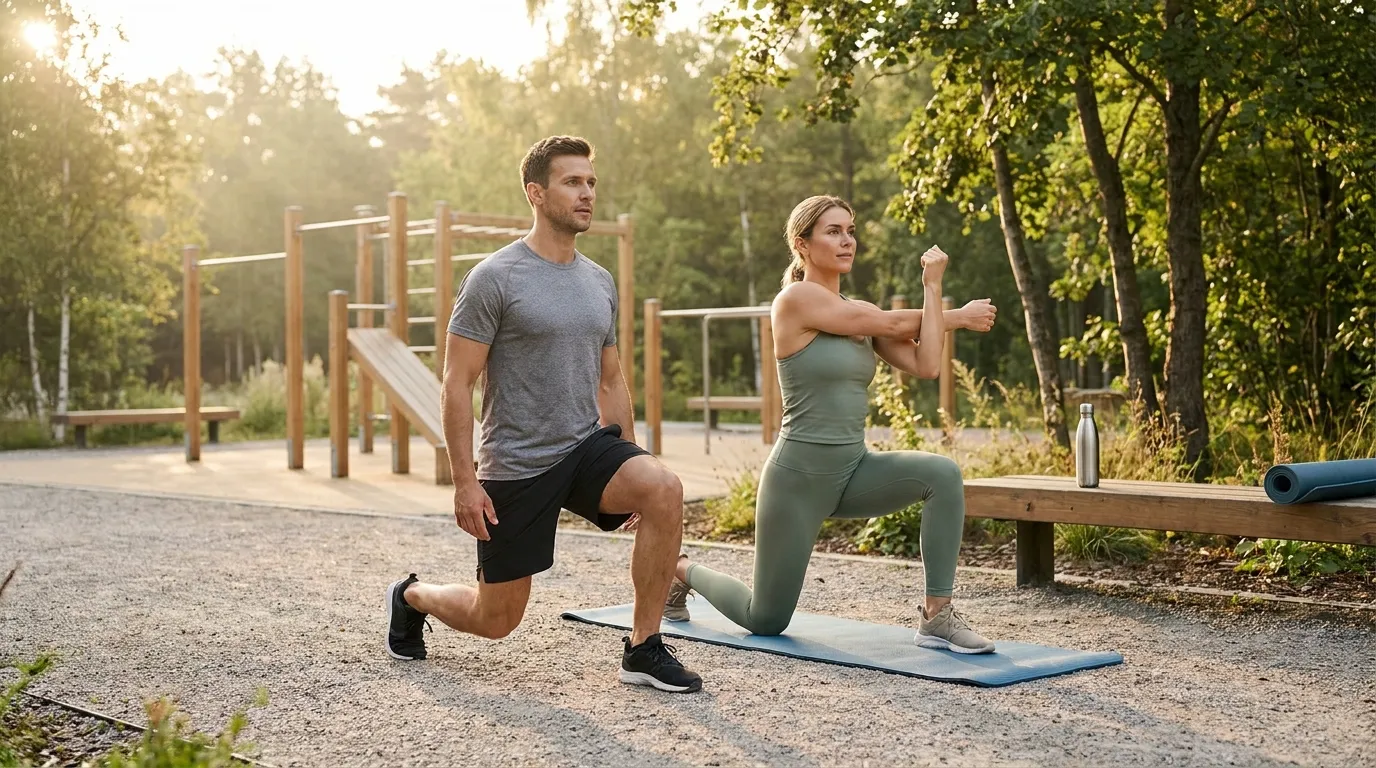
Some mornings begin slowly.
You wake up, reach for your phone, and realize you have only a short window before work, school runs, or the rest of the day takes over. That doesn't mean exercise has to disappear from the schedule.
A good morning workout can be surprisingly simple. A few squats, some upper-body work, a little core training, and several minutes of walking or mobility work may be enough to get your body moving.
The bigger question isn't whether you can squeeze the hardest possible workout into your morning. It's whether the routine makes sense for you.
Someone who has trained for years may enjoy a challenging strength session before breakfast. Someone who has spent the past few months sitting at a desk may feel much better after ten minutes of gentle movement. Both can be worthwhile.
This guide looks at different ways to exercise in the morning, from short home routines to longer strength sessions. You'll also find ideas for beginners, people with limited space, and anyone who isn't quite ready to jump out of bed and start exercising at full speed.
What Counts as a Good Morning Workout?
There isn't a single routine that deserves the title.
Morning exercise can be anything from a relaxed walk around the neighborhood to a structured strength workout. The important part is what the session does for your body and whether it fits comfortably into your day.
A useful routine often combines a few different types of movement.
You might spend part of the session getting your joints moving, then work your legs and upper body before finishing with some easy cardio. On another morning, a brisk walk might be all you need.
The amount of time available matters, too.
If you're rushing out the door, five or ten minutes may be realistic. On a quieter morning, you could have half an hour or more.
There's no requirement to make every session the same length.
In fact, giving yourself permission to have shorter workouts can make exercise easier to maintain. A ten-minute session isn't a failed version of a 45-minute workout. It's simply a different session.
Why Morning Exercise Appeals to So Many People
One of the biggest advantages of exercising in the morning is straightforward: the workout happens before the day's distractions accumulate.
Later in the day, plans change. Meetings run over. Work becomes unexpectedly busy. You might intend to exercise after dinner and then discover that you're too tired.
Morning workouts can avoid some of that uncertainty.
There is another possible advantage. After several hours of sleep, your body has been relatively still. Gentle movement gives you an opportunity to loosen up and gradually become more active.
That doesn't mean everyone needs to exercise immediately after waking.
Some people feel energetic early. Others are stiff, sleepy, or simply not interested in hard exercise at 6 a.m. If your body performs better later in the day, there is nothing inherently wrong with training then.
The best exercise time is often the one that fits your life well enough to become a regular part of it.
What Makes a Morning Routine Well Rounded?
Think less about collecting exercises and more about giving your body different kinds of movement.
A squat gives your legs and hips something to work against. A push-up challenges the muscles responsible for pushing. A row can train the upper back. A plank asks the trunk to stabilize your body.
Then there is movement that isn't really about strength at all.
Walking, marching, cycling, and other aerobic activities give you a different kind of challenge. Gentle mobility work can also be useful when you feel stiff.
You don't have to squeeze all of these into every morning.
Across a week, however, having some variety can make your training more balanced and less monotonous.
Start With a Few Minutes of Easy Movement
The first few minutes after waking aren't necessarily the best time to demand your maximum effort.
A little movement can make the transition easier.
Walk around the room. Roll your shoulders. Swing your arms gently. Try a few slow bodyweight squats. If your hips or ankles feel stiff, move them through comfortable ranges rather than forcing a stretch.
This doesn't need to resemble a formal warm-up routine.
You're simply giving your body a chance to shift gears.
Once you feel more awake, you can decide whether the day calls for strength work, cardio, mobility, or something very easy.
A Simple 10-Minute Morning Workout
Ten minutes can disappear quickly, but it is enough time for a compact full-body session.
Start with a minute or two of easy marching or walking. Let your breathing settle into a comfortable rhythm.
Then move through a few basic exercises.
Squats
Bodyweight squats are a convenient way to work the muscles around your hips and legs.
Stand with your feet in a comfortable position. Lower yourself under control and then return to standing.
If getting low feels awkward, don't force the depth. A chair can provide a useful reference while you're learning the movement.
Push-ups
Push-ups don't have to begin on the floor.
A wall variation is much easier for many beginners. Place your hands against the wall, lean your body toward it, and push yourself back.
As that becomes comfortable, you can move to a lower surface and eventually work toward floor push-ups if that suits your goals.
Glute bridges
Lie on your back with your knees bent and your feet resting on the floor.
Lift your hips slowly, pause briefly if comfortable, and lower them again.
The movement doesn't need to be dramatic. Controlled repetitions are enough.
Bird dog
Come onto your hands and knees.
Extend one arm and the opposite leg, keeping your torso reasonably steady. Return to the starting position and change sides.
This is a slower movement, which makes it a useful contrast to faster exercises.
Finish with easy movement
Use the final minute or two to walk around or march gently.
By now, you should feel more awake and physically active rather than completely drained.
That distinction matters.
A morning workout has to coexist with the rest of your day.
When You Have 20 Minutes
An extra ten minutes gives you more room to breathe.
You could begin with several minutes of easy movement, spend most of the session on strength exercises, and finish with a short walk.
For example, imagine a routine built around squats, push-ups, glute bridges, and bird dogs.
Instead of racing from one exercise to another, give yourself enough time to perform each movement comfortably. Rest when you need to.
If the routine feels easy after several weeks, you have options. You could add another set, increase repetitions, use resistance, or choose a slightly harder variation.
There is no need to make every adjustment at once.
A Beginner-Friendly Morning Workout
For someone new to exercise, the simplest routine is often the easiest place to begin.
Consider a chair squat, wall push-up, glute bridge, bird dog, and a short walk.
None of these exercises requires sophisticated equipment. More importantly, each one can be adjusted.
A chair squat can become a regular bodyweight squat.
A wall push-up can eventually move to a sturdy countertop or bench and then, if appropriate, to the floor.
A short walk can become a brisker walk or a longer one.
That's what progression can look like in real life. It doesn't always involve adding heavy weights or dramatically increasing workout intensity.
Sometimes the change is simply that an exercise which once felt difficult has become comfortable.
What About People Who Already Exercise?
If you're already active, a morning session can be more demanding.
You might use dumbbells, resistance bands, or other equipment to add resistance. Exercises such as split squats, rows, Romanian deadlifts, presses, and loaded carries can fit into a broader strength program.
The important question is how the morning workout fits with everything else you do.
Suppose you have a hard leg session planned later in the day. Adding another demanding lower-body workout in the morning may not make much sense.
On the other hand, an easy walk or mobility session could complement it nicely.
Your workout doesn't exist in isolation. Recovery, other training sessions, work, sleep, and daily activity all influence how much exercise you can handle.
The Good Morning Exercise: What Does It Mean?
There is a little confusion around the phrase “good morning workout” because good morning is also the name of a specific strength exercise.
The movement is based on a hip hinge.
Rather than simply bending forward through the waist, you send your hips backward while keeping your trunk controlled. Your knees can bend slightly as your hips move behind you.
Then you bring your hips forward and return to standing.
The exercise can train muscles along the back of the body, including the glutes and hamstrings.
Learning the movement
If you're unfamiliar with the exercise, start without weight.
Stand comfortably and place your hands across your chest or lightly behind your head. Soften your knees and slowly push your hips backward.
Your torso will naturally lean forward.
Stop when you reach a range you can control, then return to standing.
The goal isn't to see how far you can bend.
It's to learn how the hips and torso work together.
Adding weight
Once the movement is familiar, resistance can make it more challenging. However, weighted good mornings aren't necessary for everyone.
If you're new to strength training, learning the hinge without significant weight is a sensible starting point.
Anyone dealing with an injury or recurring pain may benefit from individualized guidance from a qualified professional before adding demanding exercises.
A Morning Workout Without Equipment
A lack of gym equipment doesn't have to turn your morning into a day off.
Your own body can provide resistance, while a wall, floor, or sturdy chair can make certain movements easier or more accessible.
A home session could include squats, reverse lunges, push-ups, glute bridges, bird dogs, and planks.
Walking adds another useful option.
If you have stairs available and they're safe to use, step-ups can provide another lower-body movement. In a small apartment, however, marching in place may be the quieter and more convenient choice.
The best exercise isn't always the most sophisticated one.
Sometimes it's simply the exercise that fits the room you're standing in.
Using Dumbbells in the Morning
A pair of dumbbells can expand your options considerably.
Goblet squats can add resistance to a squat. Rows can give your upper back more work. Dumbbell presses can train pushing strength, while Romanian deadlifts provide another way to practice the hip-hinge pattern.
You don't need to turn every morning into a heavy lifting session.
If you are still waking up and want something manageable, lighter resistance and controlled movements may be more appropriate.
On days when you feel fresh and have enough recovery behind you, a more challenging strength session might make sense.
Your equipment should serve the workout, not dictate it.
Should You Exercise Before Breakfast?
This is one of those questions that doesn't have to become a strict rule.
Some people enjoy exercising before eating. Others feel uncomfortable or weak if they train on an empty stomach.
Your response to food and exercise matters.
A short, easy workout may feel perfectly fine before breakfast. A longer or harder session may feel better after you've eaten.
If you're hungry, there's no particular virtue in ignoring it just because it's morning.
A small meal or snack can be useful before demanding exercise, depending on your preferences and needs.
Anyone using medication or managing a condition that affects blood glucose or exercise tolerance should follow individualized advice from a healthcare professional rather than relying on a generic morning-workout rule.
How Hard Should a Morning Workout Feel?
Not every workout needs to feel difficult.
A gentle mobility session should feel very different from a demanding strength workout. Even within strength training, effort can vary from one day to another.
One practical way to judge cardiovascular effort is the talk test.
If you can speak comfortably while exercising, you're generally working at a lower intensity than when talking has become difficult.
It's not a perfect measurement, but you don't always need a watch or app to understand how hard you're working.
Your breathing, muscle fatigue, coordination, and overall feeling during the session can provide useful clues too.
Morning Exercise for People Who Sit at a Desk
A morning workout can be especially appealing if much of your working day happens in a chair.
You might spend the session moving your hips and ankles, strengthening your legs, working your upper body, and then taking a short walk.
But there is a catch.
An active morning doesn't cancel out an entire day of sitting.
If possible, get up during the workday. Walk around while taking a break. Use the stairs when practical. Stand for part of a task if your workspace allows it.
These small moments of movement can sit alongside your morning workout rather than competing with it.
A Quiet Workout for an Apartment
You don't need jumping exercises to get a useful workout.
That can be particularly helpful if you're living upstairs or sharing a home with people who are still asleep.
Try slow squats, reverse lunges, wall push-ups, glute bridges, bird dogs, planks, and marching.
You can make many of these exercises harder without making them louder.
For example, slowing down a squat can increase the challenge. A controlled single-leg movement can require more balance. A longer walk can provide additional cardiovascular work.
Quiet doesn't have to mean easy.
Can a Morning Workout Help With Weight Loss?
It can be part of a weight-management routine, but the timing of exercise isn't a magic switch for fat loss.
Body weight is influenced by many things, including food intake, physical activity, sleep, genetics, and other aspects of health.
That makes the bigger picture more useful than chasing a supposedly perfect “fat-burning” morning routine.
If you enjoy walking before breakfast, walk.
If strength training feels better after eating, train then.
If a short workout helps you become more active throughout the week, that's valuable too.
A routine that you can maintain is generally more useful than one designed around a promise of unusually fast results.
Morning Exercise for Building Muscle
Muscle growth requires more than simply moving around in the morning.
Resistance training needs to provide enough challenge for the muscles to adapt. Recovery and adequate nutrition matter as well.
For someone focused on building muscle, a structured strength program will usually be more useful than doing the same ten-minute routine every morning.
You might train squatting movements on one day and upper-body pushing and pulling on another. Depending on your program, hip-hinge exercises and other movements can be included as well.
Over time, the muscles need an appropriate reason to adapt.
That challenge can come from heavier resistance, more repetitions, additional sets, or a more demanding exercise variation.
The exact approach depends on the person and the training program.
Morning Exercise for General Fitness
If your goal is simply to feel fitter and more capable, there is no need to specialize too quickly.
A week of activity can include strength work, walking, other aerobic exercise, mobility, and recreational activities you actually enjoy.
Maybe you lift weights twice a week and walk on several other days.
Maybe you prefer cycling, swimming, dancing, hiking, or playing a sport.
Fitness doesn't have to come from one particular style of exercise.
The morning can simply be one place where some of that movement happens.
Do You Need to Stretch in the Morning?
If you wake up feeling stiff, gentle mobility can feel good.
You could roll your shoulders, move your ankles, rotate your torso comfortably, or perform a few slow squats.
You don't need to turn this into a long stretching ceremony.
Before a more demanding workout, movements that resemble the exercises you're about to perform can help you ease into the session.
For example, a few easy squats before a harder squat workout make more sense than immediately loading up a heavy movement.
The idea is to prepare gradually rather than treating the warm-up as another workout.
What If You Wake Up Feeling Exhausted?
Some mornings simply aren't good training days.
Maybe you slept badly. Maybe yesterday's workout left you unusually sore. Perhaps work has been stressful and you feel drained before you've even started the day.
That doesn't mean you have to choose between a hard workout and doing absolutely nothing.
A gentle walk may be enough.
You could spend a few minutes on mobility exercises. You could also shorten the workout and leave the harder training for another day.
Listening to your body isn't the same as avoiding exercise.
It means recognizing that training stress and recovery belong in the same conversation.
If unusual or persistent fatigue keeps happening, it is worth looking beyond your workout routine and discussing it with an appropriate healthcare professional.
Common Mistakes That Can Make Morning Exercise Harder
Going from zero to maximum effort
An ambitious first workout can feel exciting until the soreness arrives.
If you've been inactive, give your body time to adjust. Start with manageable exercise and let your capacity grow.
Treating every morning like a test
You don't have to beat yesterday's workout every day.
Some sessions can be challenging. Others can be easier.
That's normal training, not a lack of commitment.
Choosing an exercise because it looks impressive
Advanced exercises aren't automatically better.
A basic squat performed with good control may teach you more than a complicated variation you're not ready to handle.
Turning the workout into a race
Moving quickly isn't always a sign that you're exercising effectively.
Some movements benefit from a slower pace, particularly when you're learning technique.
Give yourself enough time to feel what you're doing.
Ignoring pain
Muscles working hard and experiencing pain aren't the same thing.
Stop an exercise that causes sharp, unusual, or concerning pain. If the problem continues, appropriate professional assessment may be useful.
Trying to compensate for food
Exercise doesn't need to be punishment for eating a meal.
That mindset can make fitness feel like a constant negotiation with food rather than a normal part of life.
How Often Should You Exercise in the Morning?
There's no single number that suits everyone.
The answer depends on what you're doing.
A few minutes of gentle movement can fit comfortably into many mornings. Hard strength sessions need more consideration because the muscles involved may require recovery.
You also don't need to decide that every workout must happen before breakfast.
Perhaps Monday and Wednesday are strength days. Tuesday could be a walk. Thursday might be mobility work. Friday could bring another strength session.
The exact arrangement isn't important here.
What matters is allowing harder sessions and recovery to coexist.
Making the Habit Easier
Sometimes the hardest part of a morning workout happens before the workout begins.
You have to get out of bed.
You have to decide what to wear.
You have to figure out what exercises you're doing.
Then there's the temptation to check your phone “for just a minute.”
Removing a few of those decisions can help.
Leave your exercise clothes somewhere convenient. Know what workout you're doing before you wake up. Keep your equipment where you can reach it easily.
Most importantly, don't make the starting point unnecessarily large.
If you tell yourself that every workout has to last an hour, a busy morning can feel like a reason to skip it completely.
A shorter session gives you another option.
You may have only ten minutes today.
Use those ten minutes.
What If You Have Only Five Minutes?
Five minutes isn't enough for everything, but it doesn't have to be.
Walk around.
Do a few slow squats.
Move your shoulders and arms.
Try several wall push-ups.
Take a few deep, comfortable breaths and get on with your morning.
You can also use five minutes as the beginning of a longer session later in the day.
Exercise doesn't have to occur in one giant block to count as movement.
A More Complete 30-Minute Morning Session
With half an hour available, you can give the workout a little more breathing room.
Start with several minutes of easy movement.
Then spend roughly half the session on strength exercises such as squats, push-ups, rows, glute bridges, lunges, or another combination that fits your training level.
After that, walk briskly, cycle, march, or perform another form of aerobic exercise for several minutes.
Finish by gradually reducing the pace.
There's no need to turn the final minutes into an elaborate ritual. Simply give yourself time to come down from the harder part of the session.
How to Make the Workout More Challenging
Eventually, a routine that once felt difficult may become surprisingly easy.
That's a good sign.
It means your body has adapted.
At that point, you have several choices.
You could add a few repetitions. Maybe you use a little more resistance. Perhaps you add another set or choose a harder variation.
Technique is another form of progress.
A movement performed more smoothly, with better control and a comfortable range of motion, is meaningful improvement even when the numbers haven't changed.
There's no need to make the workout dramatically harder every week.
Progress can be gradual.
When a Morning Workout May Not Be the Best Option
There are mornings when another form of activity makes more sense.
If you're recovering from an injury, managing pain, or dealing with a medical condition that affects exercise, your routine may need individual adjustments.
The same is true if you're consistently exhausted or notice symptoms that don't seem connected to normal exercise fatigue.
And sometimes the issue is simply timing.
If you regularly feel stronger and more focused in the afternoon, there's little reason to force yourself into a demanding early-morning session just because fitness culture often celebrates early risers.
Exercise is not a competition to see who can wake up earliest.
Frequently Asked Questions
Is a morning workout good for beginners?
It can be.
Beginners often do well with simple movements that can be adjusted as they become stronger. Walking, chair squats, wall push-ups, glute bridges, and basic core exercises are possible starting points.
Is ten minutes of exercise worth doing?
Yes.
Ten minutes won't replace a complete training program when you have larger fitness goals, but it is still a useful opportunity to move.
Short sessions can also make exercise feel less intimidating.
Can I work out every morning?
That depends on the type of exercise.
Gentle walking and mobility may fit into many mornings. Hard strength sessions are different and require attention to recovery.
A varied week can be more sensible than repeating the same demanding workout every day.
Should I eat before a morning workout?
Not necessarily.
Some people prefer to exercise before breakfast, while others feel better after eating.
For longer or harder sessions, food beforehand may be more comfortable for some people.
What is the best exercise to do in the morning?
There isn't one universal winner.
Walking, squats, push-ups, lunges, glute bridges, rows, and mobility exercises can all be useful. The better choice depends on your goals, fitness level, available space, and preferences.
Is the good morning exercise suitable for beginners?
The movement can be learned by beginners, but it is worth starting with the hip-hinge pattern without significant weight.
If you're uncertain about technique, working with a qualified fitness professional can help.
Can morning exercise burn belly fat?
Exercise can support overall fat loss, but you can't reliably choose where your body loses fat first.
A broader approach involving physical activity, nutrition, sleep, and other health habits is more useful than relying on one exercise.
What should I do if I feel dizzy during exercise?
Stop the workout and move somewhere safe.
Sit or lie down if necessary and give yourself time to recover.
Significant, recurring, or persistent dizziness deserves appropriate medical attention, particularly if it comes with other concerning symptoms.
Finding Your Version of a Good Morning Workout
A morning workout doesn't need to look impressive from the outside.
Maybe yours starts with a quiet walk while the rest of the neighborhood is waking up. Maybe it's a few strength exercises in the living room before work. Maybe you have enough time for a full gym session.
Those routines look completely different, but they can serve the same purpose: helping you make physical activity part of ordinary life.
Start at a level that makes sense for you. Let the routine change as your fitness changes. Give hard sessions enough recovery, and don't be afraid of easier days.
Most importantly, don't measure the quality of a workout only by how exhausted you feel afterward.
A useful morning workout should leave you feeling that you did something worthwhile without making the rest of the day unnecessarily difficult.
Sometimes that's a demanding strength session.
Sometimes it's a brisk walk.
And on a busy morning, it might simply be ten minutes of movement before you head out the door.
That still counts.